Most garage door problems announce themselves before they strand anyone. A new noise, a door that hesitates, a remote that works from six feet but not from the street — each of those is a symptom with a short list of causes. This guide walks through the ten faults we are called out for most often in the Snoqualmie Valley, what each one usually means, what is safe to check yourself, and where the line is.
One thread runs through the whole list: a garage door is the heaviest moving object in a house, and almost all of that weight is held by springs under extreme tension. Diagnosis is something a homeowner can do. Anything that involves releasing that tension is not.
1. The door will not open or close at all
Start with the boring causes, because they are the common ones. Check that the opener has power — winter windstorms in the valley trip breakers and knock GFCI outlets out regularly, and an opener plugged into a dead outlet looks exactly like a broken opener. Check that the wall button works even if the remote does not; that single test splits the problem in half.
If the opener runs and the door does not move, the trolley has been left disconnected from the release cord. If the opener hums but nothing turns, the drive gear or capacitor is a likely suspect. If nothing happens at all and the door is heavy to lift by hand, look at the springs before anything else.
2. The door stops halfway
A door that rises partway and stops is usually hitting resistance the opener is programmed to treat as an obstruction. That resistance comes from a seized roller, a bent track, debris in the track, or a spring that no longer carries the door’s weight properly.
The diagnostic is the balance test: pull the release cord, lift the door by hand to waist height and let go. If it drifts down or shoots up, the springs are the problem and the opener is only reporting it. If the door moves smoothly by hand and only stalls under power, the opener’s force or travel settings have drifted, which is a common opener adjustment.
3. Squealing, grinding or banging
Noise is the cheapest diagnostic a door offers, and the type matters.
- Squealing or screeching — dry rollers, hinges or a dry opener rail. Often solved with a lithium or silicone lubricant.
- Grinding — a roller with a seized bearing dragging in the track, or metal-on-metal contact where a track has shifted.
- Rhythmic banging — a worn hinge or a flat spot on a roller, repeating once per revolution.
- A single sharp crack, like a gunshot — a torsion spring breaking. This is not a noise to investigate with the door open above you.
In a damp garage, dry parts get noisy faster than they would in a drier climate, because moisture strips the residual grease and starts surface rust in the same places.
4. The opener does not respond
Work outward from the door. Wall button works, remotes do not: it is the remotes — batteries first, then reprogramming. Nothing works at all: it is power, the logic board, or the safety circuit. Photo eyes that are misaligned or dirty put many openers into a state where they will close nothing and blink a code at you.
After a power interruption — and the valley gets its share every winter — openers frequently lose their travel limits or their paired remotes. That is a setup job, not a failed unit, and it is worth ruling out before anyone shops for a replacement.
5. The door closes, then immediately reverses
This is almost always the safety system doing its job, correctly or otherwise. Two causes account for most of it: the photo eyes are blocked, dirty or knocked out of alignment, or the down-force setting is too sensitive and the door reads normal contact with the floor as an obstruction.
Check the small indicator lights on both photo eyes — on most openers a steady light on both means aligned, a flicker means not. Wipe the lenses; in a garage that collects road grit off wet tires, they cloud over faster than people expect. If the eyes are clean and aligned, the close-force adjustment is next, and it should be set by someone who will retest the reversal afterward.
6. The door opens crooked or one side lags
A door that climbs unevenly is a load problem, and it is the one on this list most likely to turn into an emergency. Causes include a stretched or broken cable on one side, cables unwinding unevenly from the drums, one spring weaker than its partner, or a roller out of its track.
Stop using the door. An uneven door is on its way to coming off the track entirely, and once a door binds diagonally it can bend panels that were otherwise fine.
7. Remotes or the keypad stop working
Batteries are the first answer far more often than anything else, and cold weather shortens their useful life — a remote left in a car overnight in January can read as dead in the morning and fine by afternoon. If new batteries do not fix it, reprogram to the opener’s learn button.
If a remote works up close but not from the driveway, that is a range problem: a broken antenna wire hanging from the opener, or interference from LED bulbs or a nearby transmitter. Swapping the bulbs in the opener for ones rated as garage-door-compatible resolves a surprising number of these.
8. The door falls or slams shut
A door that drops rather than lowers has lost its counterbalance. Either a spring is broken or a cable has failed. Nothing about this is a wait-and-see situation: a double-wide insulated door can weigh well over two hundred pounds, and with the counterbalance gone that weight is unopposed.
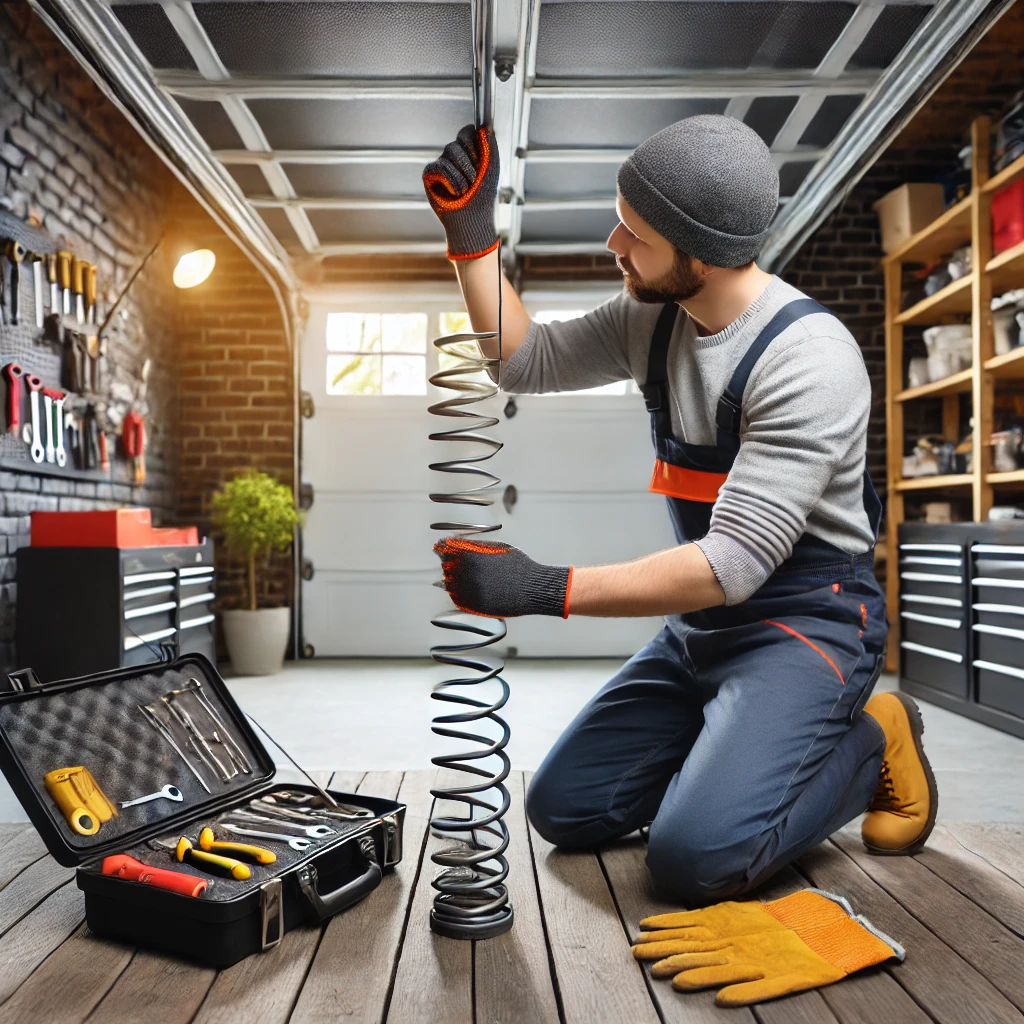
Keep people and vehicles out from under it, leave it closed, and get the springs looked at. Torsion springs are wound to a specific number of turns for a specific door weight, and adjusting them without winding bars is how people end up in the emergency room.
9. Worn or missing weather stripping
The least dramatic item here and, in this climate, one of the most consequential. A cracked bottom seal lets rainwater onto the slab and under the door, where it sits against the bottom panel. That is the mechanism behind most of the bottom-panel rust we see on doors ten to fifteen years old in the valley.
Bottom seals slide into a retainer and are a genuine homeowner job. Check the side and top seals at the same time: close the door on a bright day and look for daylight around the perimeter.
10. The door moves too slowly
Some openers have an adjustable speed setting, but a door that has gradually slowed is usually reporting friction rather than a setting. Dry or seized rollers, a track out of alignment, springs losing tension as they approach the end of their cycle life, or an opener motor that is wearing out are the usual causes, roughly in that order of likelihood.
The balance test separates them cleanly: if the door is heavy or uneven by hand, it is mechanical; if it moves freely by hand and only crawls under power, look at the opener.
What is safe to do yourself
- Replace remote and keypad batteries, and reprogram remotes.
- Clean and realign photo eyes.
- Clear debris from the tracks and wipe them dry.
- Lubricate hinges, rollers, springs and the opener rail — never the track surface.
- Replace the bottom seal and perimeter weatherstripping.
- Tighten loose hardware, without over-torquing into sheet metal.
- Run the balance test and the two safety reversal tests.
What to leave alone
- Torsion or extension springs — winding, unwinding, adjusting or replacing.
- Cables and drums under load.
- A door that is off its track or binding diagonally.
- Panel replacement on a door whose geometry has changed.
- Force and travel limit adjustments, unless you will retest the safety reversal afterward.
Common questions
The door works, but only sometimes. Is it worth calling?
Intermittent faults are worth diagnosing early, because they are usually a marginal component — a roller that binds only when cold, a photo eye that drifts, a cable starting to fray. They rarely fix themselves and they usually fail at the least convenient moment.
Can one broken spring be replaced on its own?
It can, but on a two-spring door both springs have taken the same number of cycles, so replacing one commonly means a second call within a year. Most technicians will talk through both options rather than decide for you.
How long does a typical repair take?
It depends entirely on the fault and on parts availability, so any number quoted before someone has seen the door is a guess. What we can say up front is what the diagnosis will cover and what it will cost — the estimate is free.
Do you work outside normal hours?
Yes. A door that will not close is a security problem and a car trapped behind a broken spring is a transport problem, and neither waits for Monday. The phone is answered around the clock.
Serving the Snoqualmie Valley
We come to you across North Bend, Snoqualmie, Fall City and Carnation, and across the wider east King County valley. Estimates are free and the phone is answered 24/7 — call (425) 363-9321 or send us a message. Our work is reviewed publicly — see the 5.0-star Google Business Profile (52 reviews).